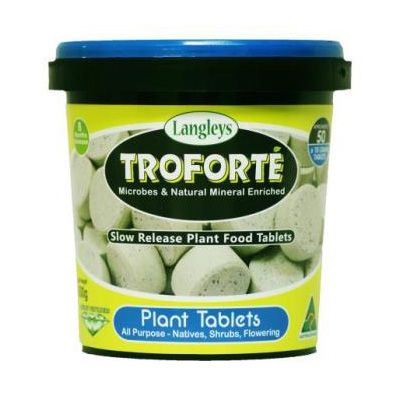
Aquatic Plant Fertiliser Slow Release Pellet 6 Pack / 500g
$ 93.87
Description Troforte® Plant Tablets are more efficient, environmentally friendly and economical than high analysis chemical fertilisers. Slow Release Microbial Fertiliser Tablets - 21-1-11 TE For all plants and soils including aquatic soil for your pond. Slow release fertiliser pellet, perfect for water lilies and all water plants. Safe with fish, frogs and aquatic life. Also safe for your household pets: Troforte® M fertilisers contain natural rock minerals and have no adverse effect on pets should they accidentally ingest it. But it does not smell and therefore is not attractive to pets. However due to the incorporation of slow release fertilisers avoid placing it in exposed heaps on the surface. It’s river and reef safe too! Potting up pond plants involves using aquatic-safe baskets, specialized heavy aquatic soil (or aquatic potting mix), and topping with gravel to prevent soil erosion and fish disturbance. Choose aquatic baskets, line with hessian or burlap if needed, add soil, place the plant, fill with soil, and top with gravel. See video attached for Repotting & Fertilizing Aquatic Plants, courtesy - AquascapePonds Steps for Potting/Repotting Pond Plants: Prepare the Container: Use plastic aquatic baskets with mesh sides, which allow water flow and prevent the soil from turning anaerobic (oxygen-depleted). Line with hessian or coconut fiber liner to keep soil in. Prepare the Plant: Remove the plant from its old pot, trimming off any dead foliage or roots. If pot-bound, gently tease the roots apart or cut into sections for division. Soil Selection: Use a heavy, clay-based soil or a commercial aquatic potting mix. Do not use regular potting mix, as it is too light, contains too many nutrients, and will cause algae issues. Planting: Place a small amount of soil at the bottom. Position the plant, then fill around it with soil, pressing it down firmly. Keep the crown (where stems meet roots) just above the soil level. Fertilizing: Push 1–2 aquatic fertilizer tablets into the soil near the roots for long-term nutrition. Finishing: Top the soil with a 20mm layer of gravel or pebbles to keep the soil in place and prevent fish from digging. Placement: Slowly lower the plant into the pond to prevent soil washout. For best results, place it in a shallow spot first or use a floating ring to allow it to establish Troforte® Plant Tablets are made with a special mineral base that includes up to 60 minerals and a carefully balanced mix of up to 24 types of beneficial soil microbes. These include bacteria, fungi, and algae that perform important functions in the soil, such as: • Fixing nitrogen • Building nutrients • Producing natural plant growth hormones • Breaking down organic matter into carbon • Releasing antibiotics to help protect against harmful microbes like root rot and fungi • Improving soil structure Some of the helpful microbes included are: Azobacter, Azospirillum, Bacilli, Cellulose-degrading fungi, Myxobacteria, Phosphobacteria, Pseudomonas, Rhizobium, Streptomyces, Saccharomyces, Trichoderma, VAM, and Yarrowia. Certain bacteria also help by breaking down minerals and releasing important nutrients like potassium, phosphorus, magnesium, calcium, and iron. Others produce plant growth hormones such as auxins, gibberellins, and cytokinins. These beneficial microbes can carry out a wide range of biological activities within the soil such as Nitrogen-fixing, nutrient building, producing growth hormones, decomposing organic matter to organic carbon, protecting beneficial bacteria by releasing antibiotics that can assist in inhibiting disease producing microbes like root rot, fungi, and pythium, as well as conditioning soils by improving soil structure. Some types of bacteria break down minerals to release nutrients like potassium, phosphorus, magnesium, calcium, and iron, making them easier for plants to use. Other bacteria produce natural plant growth hormones such as auxins, gibberellins, and cytokinins. Since most nitrogen in soil doesn’t dissolve in water, this method provides a steady supply of carbon and nitrogen through the action of microbes. This also helps grow and maintain healthy populations of beneficial microbes in the soil. Consider the benefits of Troforte® Plant Tablets • Insures your plants against transplant shock • Provides up to 8 months of nutrients • Contains a specially selected suite of beneficial soil microbes and minerals • Easy to use – Simply drop in the tablets into the planting hole • Contains a full spectrum of trace elements Apply at the beginning of every Spring and Autumn to maximize plant health and vigour. APPLICATION RECOMMENDATIONS FOR SOIL In Ground- place the tablet halfway up the side of root ball, near the root ball. Back fill and water in. Young Trees 4-6 x 10 g Tablets Matured Trees 16-20 x 10 g Tablets In Pots - place the tablets beneath the surface towards the edge of pot. Pots up to 150 mm 1 x 10 g Tablet Pots 175 to 255 mm 2 x 10 g Tablets Pots 300 to 400 mm 4 x 10 g Tablets In Containers - place the tablets beneath the surface towards the edge of the container. 10 litre bag 2 x 10 g Tablet 20 litre bag 4-6 x 10 g Tablets 45 litre bag 6-12 x 10 g Tablets SUITABLE for all types of plants where high Potassium feeding is required including Phosphorus sensitive varies. STORAGE - Troforte® has exceptional shelf life and contains beneficial soil microbes that are activated when exposed to moisture. We recommend the storage of opened and unused fertiliser for a maximum of 11 months in a moisture -free environment to ensure best results upon application. TYPICAL ANALYSIS MACRO ELEMENTS Total Nitrogen (N) - 20.70 %w/w as Ureaform - 17.29 %w/w as Urea - 1.41 %w/w as Nitrate - 1.00 %w/w as Ammonium - 1.00 %w/w Total Phosphorus (P) - 1.20 %w/w Water Soluble - 0.93 %w/w Citrate Soluble - 0.27 %w/w Total Potassium (K) - as Sulphate 10.50 %w/w MICRO ELEMENTS Sulphur (S) as sulphate - 4.60 %w/w Magnesium (Mg) as sulphate - 0.45 %w/w Iron (Fe) as sulphate - 0.36 %w/w Zinc (Zn) as sulphate - 0.08 %w/w Copper (CU) as sulphate - 0.05 %w/w Manganese (Mn) as sulphate - 0.08 %w/w Boron (B) - 0.01 %w/w